Answer 27 October 2026
How much time does a LinkedIn team need from me?
A week is 10,080 minutes. Each stroke is one of them, 7 bands for 7 days. The 15 lit strokes are your part.
The short answer
A LinkedIn team needs about 15 minutes a week from you, which is also the figure on our homepage. It holds because we ask you for each thing once and write the answer into a record the whole team can open.
 By Vedish KukshalCo-founder, Snowball
FIGURE
One week, one dot per minute
Drawn to scale: 10,080 dots, 15 of them yours
10,080minutes in a week
7 days × 24 hours × 60 minutes
15of them are yours
open the lineup, say yes, change a line
One dot is one minute, and the 7 bands are the 7 days. A client spends about 15 minutes of the week with us, which is also the figure on our homepage. The day and hour of the 15 here are for illustration.
What a LinkedIn team costs you in time is the number of times it comes back to ask for something it already has.
Why does the time cost come from asking twice?
It is very simple: a team with no record has no memory. Every new week and every new writer starts the same small interview over, with what you think about this, which words you hate, who must never be mentioned and which photo to use. Each repeat costs you a few minutes, and they pile up faster than the posts do.
FIGURE
Asked twice, or asked once
Six weeks, the same four asks
An illustration of six weeks. A team with no record has no memory: every new week and every new writer starts the same small interview over, with what you think about this, which words you hate, who must never be mentioned and which photo to use. Your answers go into the record once, and the record answers the rest.
Our own delivery shows it. The slowest stretches were the weeks we spent waiting on something only the client could give.
FIGURE
Weeks spent waiting
Client-side waits, April to September 2026
In our delivery audit of 12 September 2026, covering April to September 2026, 3 of the 7 accounts in its client table were waiting on the client’s side for 7, 5 and 3 weeks. The audit’s own words: that waiting dominates calendar time and has no clock. Source: Snowball delivery audit, 12 September 2026.
That is why the list of asks below is short, and why each item on it happens once.
What do you give us, and when?
FIGURE
What we ask for, in the order it happens
Four asks, drawn in the minutes they take
- DAY 1
One recorded call
60 to 90 minutes, once, on day 1.
- WEEK 1
Photos, login and limits
Week 1, once: 2 headshots, 4 full-body shots, a secure link and the topics off limits.
- EVERY WEEK
One lineup a week
Open it, say yes, change a line or ask for a change.
- EVERY MONTH
A monthly review
Our template sets a written summary and a 20-minute call.
Each ask happens once, in this order, except the weekly lineup and the monthly review. One moss dot is one minute of yours.
The call is the big one. Our script books 90 minutes (the 3 calls in the chart below ran 58, 71 and 139) and tells you 60 to 90 depending on how fast we go. Wouldn't you rather give us that hour once than 10 minutes every week editing drafts that don't sound like you?
FIGURE
The hour, against the minutes
60 to 90 minutes once, or 10 minutes every week
Our script books 90 minutes and tells you 60 to 90, depending on how fast we go. Against it: 10 minutes every week, editing drafts that don’t sound like you. An illustration of the question above, not a measurement. Wouldn’t you rather give us that hour once?
FIGURE
How long 3 of our onboarding calls ran
One dot is one minute
How long 3 of our onboarding calls ran: 58, 71 and 139 minutes, shortest to longest. One dot is one minute, so each disc is the call. The moss dots are 15 minutes, one ordinary week. Source: 3 recorded onboarding calls with clients, 2026, our call recordings.
So I never have to ask you the same question twice.
How does the system keep the weekly part near 15 minutes?
Your answers go into the record once, and the ideas come from what we already hold before they come from you.
| Asked again each time | Asked once, kept | |
|---|---|---|
| Your voice | Re-explained to each new writer | One recorded call, written into a voice file |
| Off-limits topics | Remembered by one person | A rulebook every post is checked against |
| Photographs | Chased by message | One folder, asked for on day 0 |
| Ideas | Asked of you every week | Built from calls and messages we already hold |
| Approval | Spread across threads | One lineup, one answer |
Every call with us is recorded and read for facts and topic ideas, which is how a story can reach a post without a request to you. The record is also built to turn an edit you keep making into a rule.
You also choose how much you approve. Some founders say yes to the angle of each post and again to the finished post, and on one of our accounts the founder doesn't review drafts at all: posts go out on schedule and the founder reacts in the group afterwards.
Isn't more of your time better?
The fair objection is that more of you makes better posts, and a founder who writes his own drafts will beat any record on voice. Our files support one thing here: a voice can be measured from what you already say on calls and in messages, so the weekly part doesn't have to carry it. I have not tested whether 15 minutes a week beats 60, and I'd rather say that than guess.
What pushes a week past 15 minutes?
What stretches a week past 15 minutes
- 01
The first weeks
The call, the photographs and the login sit outside the weekly figure.
- 02
A story only you hold
On one account the pipeline sat blocked twice on a voice note from the client.
- 03
Approving every angle and rewriting lines
Both are fine and both cost time, and the record keeps every edit you make.
If you enjoy writing and only want someone to publish and report, an editor fits better than a team. And if strategy, pictures, publishing, replies and reporting already have an owner on your side, you would be paying for that team twice.
What should you ask any provider about your time?
5 questions to ask about your time
- 01
How many times will you ask me for my voice, and where is the answer kept?
A good answerOnce, on a recorded call, written into a file you can read.
- 02
What do you need from me each week?
A good answerOne lineup to read and answer, stated in minutes.
- 03
What happens when I don't reply?
A good answerA clock: the post waits or goes by a rule you set, and you hear about it.
- 04
Where do the ideas come from?
A good answerYour calls and messages with us and the sources you follow.
- 05
What happens when I correct the same thing twice?
A good answerIt becomes a rule that gets asked once.
Ask how many times they will ask you for the same thing.
Questions
How much time does LinkedIn content take for a founder?
About 15 minutes a week once you are set up. At the start there is one recorded call of 60 to 90 minutes, a few photographs and a secure login link, which sit outside the weekly figure. After that you read one lineup a week and answer it, and the team asks for each thing once.
Do you have to approve every LinkedIn post?
No. You choose how much you approve. Some founders say yes to the angle of each post and again to the finished post, and on one of our accounts the founder does not review drafts at all: posts go out on schedule and the founder reacts in the group afterwards.
How long is the onboarding call?
Our kickoff script books 90 minutes and tells you 60 to 90 depending on how fast we go. 3 recorded onboarding calls in 2026 ran 58, 71 and 139 minutes. It happens once, on day 1, and the answers go into a record so nobody asks you the same question again.
Keep reading
- Answer
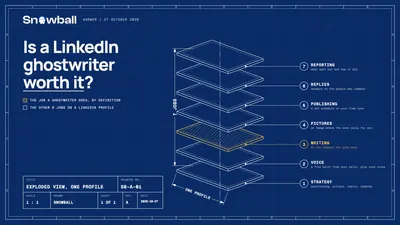
Is a LinkedIn ghostwriter worth it?
A LinkedIn ghostwriter is worth it if the other 6 jobs have owners. If one person owns all 7, your voice drifts and your account's history lives in one head.
- Answer
What is a good number of impressions on LinkedIn?
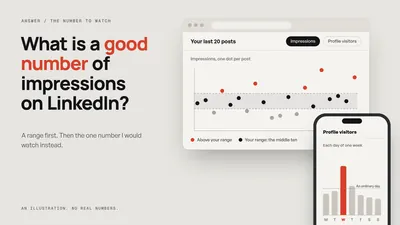
A good number of impressions on LinkedIn is a range set by your last 20 posts. Profile visitors on the day you post say more about whether it brings business.