Field note 27 October 2026
How do you run a discovery call?
listen first. the gap comes second.
 By Vedish KukshalCo-founder, Snowball
In short
To run a discovery call, I diagnose before I pitch. I want to know how much this person has built, how much of it other people can see, and whether they see the gap themselves. If the gap is real and they see it, I explain what Snowball does, and if it isn't, we stop there.
A discovery call is the first call where you learn whether the person has a problem worth solving, and the most useful thing I do on one is decide not to sell, which cost me deals before I understood that.
Where did this come from?
The first thing I ever sold was a funnel, at 14, and nobody had to be pushed because the person wanted it. At 17 I was selling machines at a $3,000 ticket size, and I made hundreds of cold calls to nutritionists in India, sure that my job was to explain how good the machine was. So I talked, and talked, and the person on the other end slowly went quiet.
The ticket size of the machines I sold at 17: $3,000
The machines I sold at 17 had a $3,000 ticket size. Hundreds of cold calls to nutritionists in India after school, and a few machines sold at this ticket size. Source: my own account, recorded 11 June 2026.
I lost a lot of those deals. The calls I closed were the ones where I shut my mouth and let the person tell me what was wrong, and that is when I realized I had the job backwards. I was there to solve a problem, so if the problem didn't exist there was nothing for me to push.
Why does pitching first make the call worse?
It is very simple. Push a solution at someone and they feel attacked, and a person who feels attacked defends and stops telling you what is wrong. What is wrong is the only thing I came to learn, so every minute I spend pitching is a minute of diagnosis I lose.
The same call, run in 2 orders: pitch first, and diagnose first
The same call, run in 2 orders. Pitch first and the other person defends. Diagnose first and the exit is allowed to be nothing.
I think of a doctor. He doesn't hand you medicine when you walk in, he asks questions, works out how bad it is, checks whether you know you have it, and only then writes the prescription (and if you don't need one, he lets you go).
How to run a good discovery call?
I ask first and say nothing about the product until the person has told me what is wrong.
The order of my questions on a first call
Their position: how much they have built, and how much people can see. The symptoms: do they match people we have worked with. How urgent: how badly they need it now. What we do: only if the first 3 line up. Then I wait: I never push it at them.
After I say what we do, I stop talking and wait for them to answer.
What do I read before the call?
Before every first call I put the person's public record next to their LinkedIn: on one side what they have built, in dated public facts, and on the other what the profile shows. The gap goes into one line, together with the one thing I would fix first.
The read before a first call
I do this before every first call. An illustration, not a real person. Things anyone could check: a company, a fund, a book, a date. Followers, the date of the last original post, the median reaction count.
Isn't a diagnosis just a pitch with extra steps?
A fair challenge, and the difference is the exit. In a pitch the call ends with the product, and in a diagnosis I am allowed to end it with nothing. If the person can't see the gap, I don't pitch: someone who can't see the gap won't see why they would pay to close it, and I would rather spend that hour with someone who can. All I can do is show them their profile next to their own record, and then it is their call.
Snowball fits someone who has built something their profile doesn't show. Where nothing has been built yet there is no gap to close, and I say that out loud.
The calls I actually closed were the ones where I shut my mouth.
Where does this cost me?
The risk is that I leave money on the table by not pushing harder. Diagnosing patiently means I rarely give anyone a reason to decide this month, and I haven't solved that yet. I'm trying to learn how to create urgency that is honest, and I'd like to hear how you do it.
What would you find if you ran it on yourself?
Open your profile. When did you last post something original, and how many reactions did it get?
Questions
What is a discovery call?
A discovery call is the first call where you learn whether the person has a problem worth solving, before you say anything about your product. I use it to find out what they have built, how much of it others can see, and whether they see the gap. If they do not, I do not pitch.
How to start a sales call?
Before the call I put the person's public record next to their LinkedIn, so I know the gap in one line and the one thing I would fix first. On the call I ask questions and let them say what is wrong, and I leave the product out until I know the gap is real.
How to run a good discovery call?
Diagnose before you pitch. Let the person tell you what is wrong, check whether they see the gap, and explain what you do only if they do. Keep the right to end the call with nothing: in a diagnosis the exit is allowed, and that is what separates it from a pitch with extra steps.
Keep reading
- How we work
What happens to my LinkedIn voice if a writer leaves?
If your writer leaves, your LinkedIn voice survives only if it is written down where the next person can open it. This is what our record holds and its limits.
- Answer
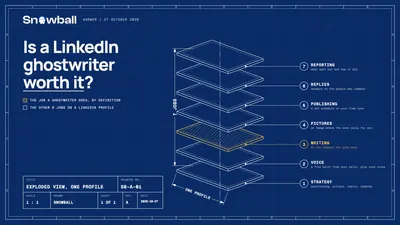
Is a LinkedIn ghostwriter worth it?
A LinkedIn ghostwriter is worth it if the other 6 jobs have owners. If one person owns all 7, your voice drifts and your account's history lives in one head.