How we work 27 October 2026
What happens to my LinkedIn voice if a writer leaves?
In short
If a writer leaves, your LinkedIn voice survives only if it was written down somewhere the next person can open. Ours is: we build a voice file from your own calls, messages and posts, keep a rulebook of what you have ruled out, and hold both in one record the whole team can open.
 By Vedish KukshalCo-founder, Snowball
A voice file describes how one person sounds: the words they use, the words they never use, how their sentences run, how they open and how they close.
Where does a voice go when the person who knew it leaves?
In September 2026 we audited our own delivery, April to September, and found our work stored the way a writer's memory is stored: in whoever did it. On one account the weekly flow was locked in April, with an automatic draft on Saturday, a review by our co-founder Tanvee, an approval on Sunday and posts scheduled all week.
It ran until the account ended in August. What kept it running was Tanvee's Sunday relay, so when the account ended the pattern ended with it, and the audit's line for that is "Automation that existed died with its person."
Kept in a head. The voice leaves with the person.
Written down. The next person opens the record. The next one picks up where the last one stopped.
The record: voice file, rulebook and every call in one place.
On another account, 3 formats were each marked as the current one (April, July to August, September), and nothing reconciled them.
One record that the whole team can open.
Every call is recorded and matched to you, the voice file, rules and plan are written from them, and each working session ends with a note on what changed and who is waiting on whom.
v1, v2, v3: every version is kept
Who wins when 2 of them disagree?
It is very simple: your rules win first, then your voice, then our house defaults.
The order a draft is judged in
Your rules win first, then your voice, then our house defaults.
Two example drafts. The first sounds exactly like you and still fails at the first gate. The second passes all 3 and reaches you.
So a draft that sounds exactly like you still fails if it uses a word you have ruled out. The words on your never list are built to fail the voice check before a post reaches you.
How is the voice file built, and does it change?
The machine writes it from your calls, your messages, your posts and your edits, and nobody on our side types it by hand. When a new call lands the voice is rebuilt and every version is kept, so the file you read today will change.
One of our accounts had a voice file at version 3 on 3 October 2026, built from 1 recorded call and a large set of the founder’s own messages.
Source: Snowball OS record, read on 8 October 2026.
What can a record not do?
It can only describe a voice it has seen, so a founder with few posts gives it little to measure and the first weeks lean on the onboarding call. It can't invent a story that only you hold, which means some posts still wait on a voice note from you, and the never-word check is only as good as the file behind it. What it gives a good writer is a place to start: the next one picks up where the last one stopped.
Our delivery system went live on 22 September 2026 (the date of its first release), so some accounts are further along than others. And the record is built to turn a fix you keep making into a proposed rule, although none had been recorded by 1 October 2026.
What should you ask any provider this week?
3 tests to run on any provider
- Test 1
Can I read my voice file today?
A good answerA file you can open, written from your own words. - Test 2
Pick a word I never use. Is it on a list that every draft is checked against?
A good answerYes, and a draft that uses it fails. - Test 3
What did the last person leave for the next one?
A good answerA note that says what changed and who is waiting on whom.
If the answer is one person, a resignation on their side is also a loss of your voice on yours.
Questions
What is a LinkedIn voice file?
A voice file is a written description of how one person sounds: the words they use, the words they never use, how their sentences run, and how they open and close. Ours is built from your own calls, messages, posts and edits, and every version is kept, so the file you read today will change.
Can a new writer pick up my LinkedIn voice?
Yes, if it is written down. The next writer opens the voice file, the rulebook and every call in one record, and starts from a hand-off note that says what changed and who is waiting on whom. They do not start from memory or from the last few posts you approved.
If my rules and my usual voice disagree, which wins?
Your rules. A word you have ruled out fails the voice check even when your own writing would use it. Then your voice applies, and our house defaults come last. So a draft that sounds exactly like you still fails if it uses a word on your never list, before it reaches you.
Keep reading
- Answer
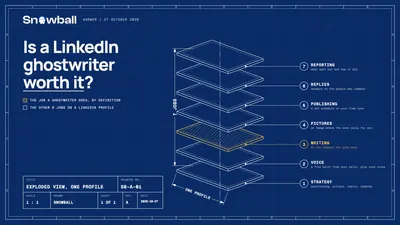
Is a LinkedIn ghostwriter worth it?
A LinkedIn ghostwriter is worth it if the other 6 jobs have owners. If one person owns all 7, your voice drifts and your account's history lives in one head.
- Answer
How much time does a LinkedIn team need from me?
A client spends about 15 minutes a week with us. This is how Snowball keeps your part there: the team asks for each thing once and keeps the answer in a record.